There is a gathering storm in the legal community-and tonight the question is whether the winds of change will sweep Chief Justice Louise Blenman out of office when she reaches retirement in March of next year.
As we have reported, she has highly placed supporters in the Bar Association who are lobbying to keep her in the post on contract extension. But reports to 7 News say there is growing opposition to that in the broader legal fraternity.
Her possible reappointment forms the backdrop to a wider debate about a foreign High Court bench. And it could all play out when the Bar Association meets next Friday.
In what we're told is a hastily called meeting, the agenda prominently lists the burning issues of the day, namely: Judicial Appointments, and Public Sentiment on a Foreign Judge.
One of the most prominent members of the bar is Senior Counsel Eamon Courtenay, and in an interview yesterday, he conceded that he believes that the JLSC is holding Belizean applicants for judicial posts to a higher standard.
We asked him if Belize should have a homegrown Chief Justice:
Reporter:
"Apart from the Eastern Caribbean states, Belize is the only Caribbean country has a foreign Chief Justice. Is it your view that the Chief Justice should be Belizean?"
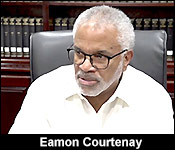 Eamon Courtenay, Attorney
"My position remains the same. If we have two candidates, three candidates, and a Belizean is among them-and when you look at the criteria, experience, ability, and the Belizean is equal to the rest of them-let's promote the Belizean. If, in fact, among those three you find somebody from Barbados, Jamaica, Guyana, Australia who is head and shoulders in terms of experience, etc., above the Belizean, I don't think we should necessarily give the Belizean and then complain that backlog is growing, it's not being properly administered, etc., etc. We have a problem. Belizeans in the legal profession, by and large, don't want to go into the judiciary; they are not prepared to serve, at least they're not prepared to serve full-time, and I know that the current Chief Justice, previous Chief Justices, have tried to recruit people and they say, 'Oh, I can't do it now, maybe in five years, ten years'-they don't wanna do it. Perhaps one of the things we should be exploring-and I know that some of it is being done-is to give more judicial training for Belizeans who are in magistracy or the registry, to expose them to the Judicial Education Institute, to give them on-the-job training to prepare them so two, three years down the road, they can apply and we can't then say that she this and he that, they have gone through a course of training, they have served four, five years-long and short of it, that's why I said the system needs to be looked at. We are facing a problem, there's a public concern, and it needs to be addressed in a sober way. And I think that the government is attempting to do that."
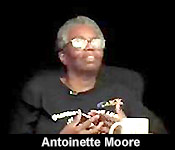
And while Courtenay publicly concedes there is a problem-the woman who got the entire public conversation started is retired Supreme Court Justice Antoinette Moore, when she issued a statement earlier this week. Speaking on a University of Belize show called Legal Link Up, she discussed the foreign judiciary:
Antoinette Moore, Former Judge
 "I would hope that-and I'll use this word now for probably the third time-I would hope that we could have some balance in the judiciary in Belize. Now, I wasn't born here and I wasn't raised here; I came over 30 years ago, and this is home. I always say I wasn't born here, but I'll be buried here. This is home-I even get emotional thinking about it; I love Belize to my core. But I am not a roots Belizean, as the term used to be, so I could never say you should select your judges only from those persons who were born here; I couldn't say that, that would be hypocritical of me to say that. And I do believe that we need to have a balance within the judiciary. I don't believe that 100% of our judges or magistrates should be from elsewhere. So I'm not saying it needs to be 50%, or 30, or 40, but there needs to be balance, and there needs to be some consideration and thought into the fact that the people who are from a particular jurisdiction will have a deeper understanding of that culture and society, and those things do play a role in decision-making. There is just no way that they don't play a role; they do. It may not be the biggest role or the biggest factor, it's on a case-by-case basis, but it does play a role. Beyond just the judge or the magistrate understanding the society of what the case arises out of, you also want to encourage again the younger people in Belizean, the Belizean youths who want to go into law, to see that you can ultimately rise to be a judge and not think that all of the judges will always come from somewhere else."
The show was recorded before Justice Moore released her statement. You can find it on the UB Facebook page.



 Email
 Print